
Content architecture built for AI visibility
AI visibility is not fixed by publishing more content. It improves when AI engines can understand what you do, where your proof sits, and how your pages connect to the buyer journey.
Odyssiant’s Content Architecture Map shows whether your site has the right structure to be found, trusted and cited by AI engines.
It combines AI answer evidence, cited sources, sitemap data and a content architecture scan of your site. The result is a practical map of what to create, strengthen, connect or validate.
The problem is rarely “not enough content”
Most AI visibility tools can show whether your brand appears in an answer. That is useful, but it does not tell you what to fix.
A low score might mean your product page is missing. It might mean the page exists but is underused. It might mean your proof is hidden, your case studies are disconnected, or third-party sources are telling a stronger story than your own site.
Without that diagnosis, teams fall back on the default answer: write more content.
That is often the expensive mistake.
What the Content Architecture Map does
Odyssiant scans your site and compares what exists with what AI engines are actually using in answers.
It helps identify:
- pages that are missing
- pages that exist but are underused
- pages that are working
- pages that need stronger proof
- evidence gaps
- weak or missing buyer-journey connections
- third-party source opportunities
- content that should be strengthened rather than recreated
This turns AI visibility from a measurement problem into an action plan.
From AI answer evidence to site architecture
The Content Architecture Map brings together four layers of evidence.
AI answer evidence
Odyssiant analyses how AI engines answer buyer questions about your product, where you appear, which competitors are mentioned and which sources are cited.
Site structure
The platform reads your sitemap and runs a capped content architecture scan, so it can understand which pages exist and what role they appear to play.
Evidence and proof
It looks at whether your claims are supported by visible proof: case studies, data, reports, certifications, reviews, comparisons and trusted third-party sources.
Buyer journey fit
It maps content against the buyer journey, so recommendations are tied to how people actually research, compare and decide.
What it can tell you
The map does not simply produce a list of blog ideas. It diagnoses the type of fix required.
The page is missing
AI engines are answering a buyer question your site does not address. A new page is needed to give them something to reference.
The page exists but is underused
The right page exists, but it is buried, weakly connected or not surfaced where AI engines are looking. The fix is structure, not creation.
The page is working but needs support
Your page is being used, but it needs adjacent content, internal links or supporting proof to perform consistently.
The issue is evidence, not content
The claim exists, but the proof does not. Case studies, data, comparisons or customer evidence need to be made visible and accessible.
The issue is external validation
Third-party sources are telling a stronger story than your own site. Listings, reviews, analyst mentions or partner pages need attention.
Built for marketers, agencies and web teams
The Content Architecture Map is designed to help teams move from audit to implementation.
It is especially useful before a website rebuild, product campaign or AI visibility improvement programme because it creates a practical bridge between strategy, content and site architecture.
Marketing teams
See where content and proof should focus, and turn AI visibility findings into a clear plan of action.
Agencies
Shape content plans, page templates and campaign strategy around what AI engines are actually using in answers.
Web teams
Understand which pages need clearer structure, internal links or crawlable evidence before a rebuild or release.
Not more content. Better architecture.
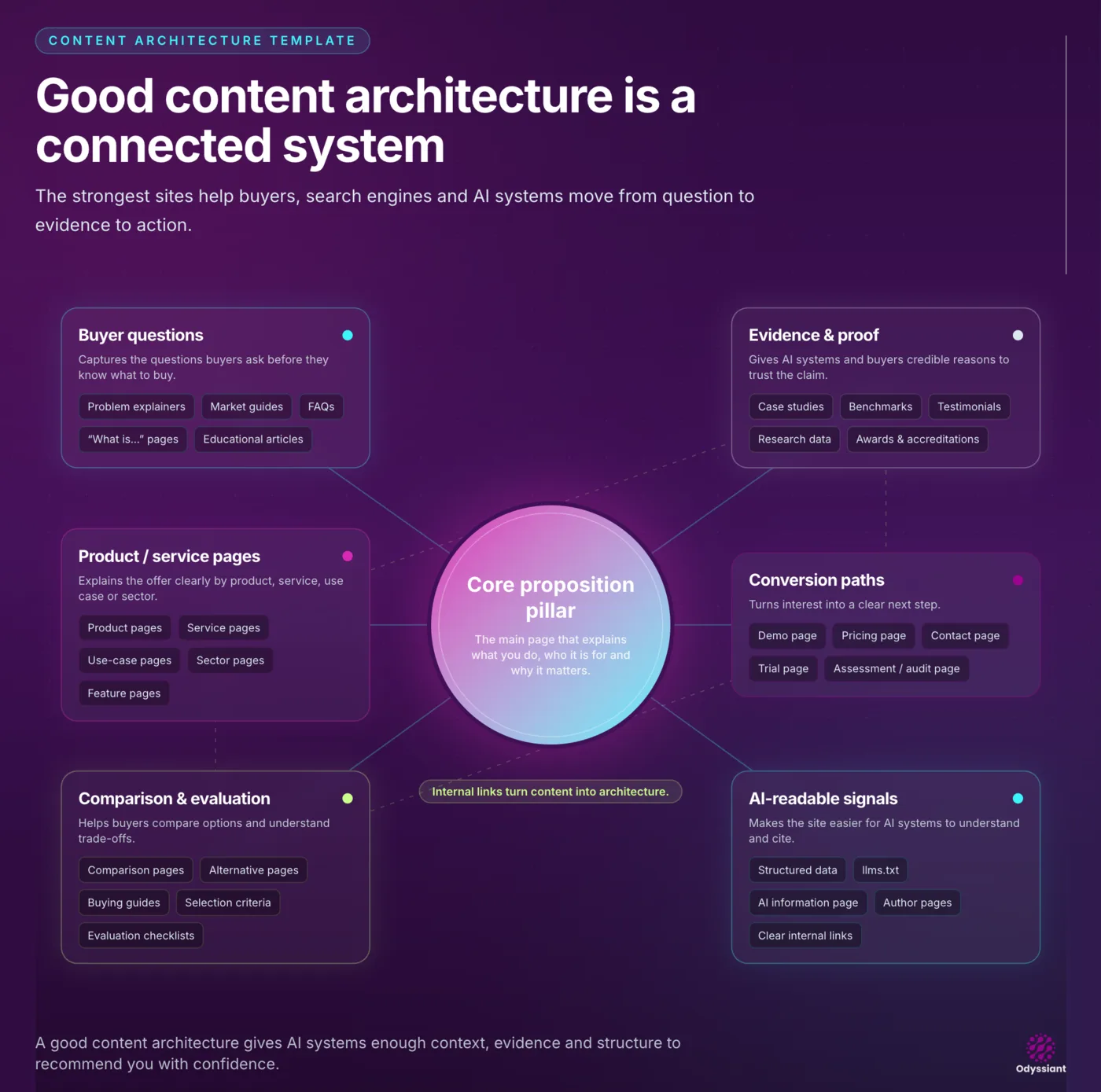
AI engines do not just need content. They need a coherent content system.
They need to understand:
- What the product is
- Who it is for
- Which problems it solves
- How it compares
- Where the proof is
- Which pages matter most
- Which sources support the claims
- How the content connects across the buyer journey
That is what the Content Architecture Map is built to reveal.
Part of the Odyssiant AI visibility platform
The Content Architecture Map sits alongside Odyssiant’s product-level AI visibility audit, Evidence Layer, competitive analysis and action recommendations.
Together, they show:
- How AI engines describe your product
- Where competitors are stronger
- Which sources shape the answer
- What your site already contains
- What needs to be created, improved or validated
- Which actions should be prioritised
Seeing the gap is useful. Knowing how to close it is where the value is.
Frequently asked questions
What the Content Architecture Map does, how it differs from an SEO audit, and why content architecture matters for AI visibility.