
Revolut Business Multi-Currency Account scored 29/100 for AI visibility
Revolut Business is a well-known fintech brand with a strong multi-currency business banking proposition. But when its Multi-Currency Business Account was tested across 516 AI-led buyer prompts and four AI engines, the audit revealed a major gap between competitive strength and early-stage product discoverability.
The product led its answer-driven competitor set, but still scored only 29/100 overall. The strongest answers appeared when Revolut Business was named directly. The weakest answers appeared when buyers asked broad, vendor-neutral questions about managing multiple currencies in international business.
This is a public demonstration audit. Revolut Ltd. is not represented as an Odyssiant customer, partner or participant.
Why this audit matters
Revolut Business is a recognised fintech brand. But brand recognition does not guarantee that a specific product appears when buyers ask AI-led research questions.
Businesses looking for international banking support may not start by asking about Revolut. They may ask how to manage multiple currency accounts, reduce transaction fees, improve FX control, simplify accounting, or compare multi-currency providers.
A product-level audit shows whether Revolut Business Multi-Currency Account appears in those moments.
For Revolut, the audit revealed a mixed picture: strong competitive positioning once the product entered the conversation, but very weak awareness-stage visibility when buyers asked broad category questions.
What was measured
- Company assessed
- Revolut Ltd.
- Product assessed
- Multi-Currency Business Account
- Audit type
- Product-level AI visibility audit
- Run date
- 1 May 2026
- Total prompts
- 516
- Answers scored
- 476
- Coverage
- 92%
- Engines tested
- 4
AI engines tested
Themes audited
Buyer stages audited
The headline finding
Revolut Business Multi-Currency Account achieved an overall AI visibility score of 29/100. The most important finding was the awareness-stage gap. Across 146 awareness prompts, the average score was just 3/100.
That means AI could explain multi-currency account concepts, international currency management and business banking options, but did not reliably surface Revolut Business as a relevant product unless the buyer had already moved deeper into the journey.
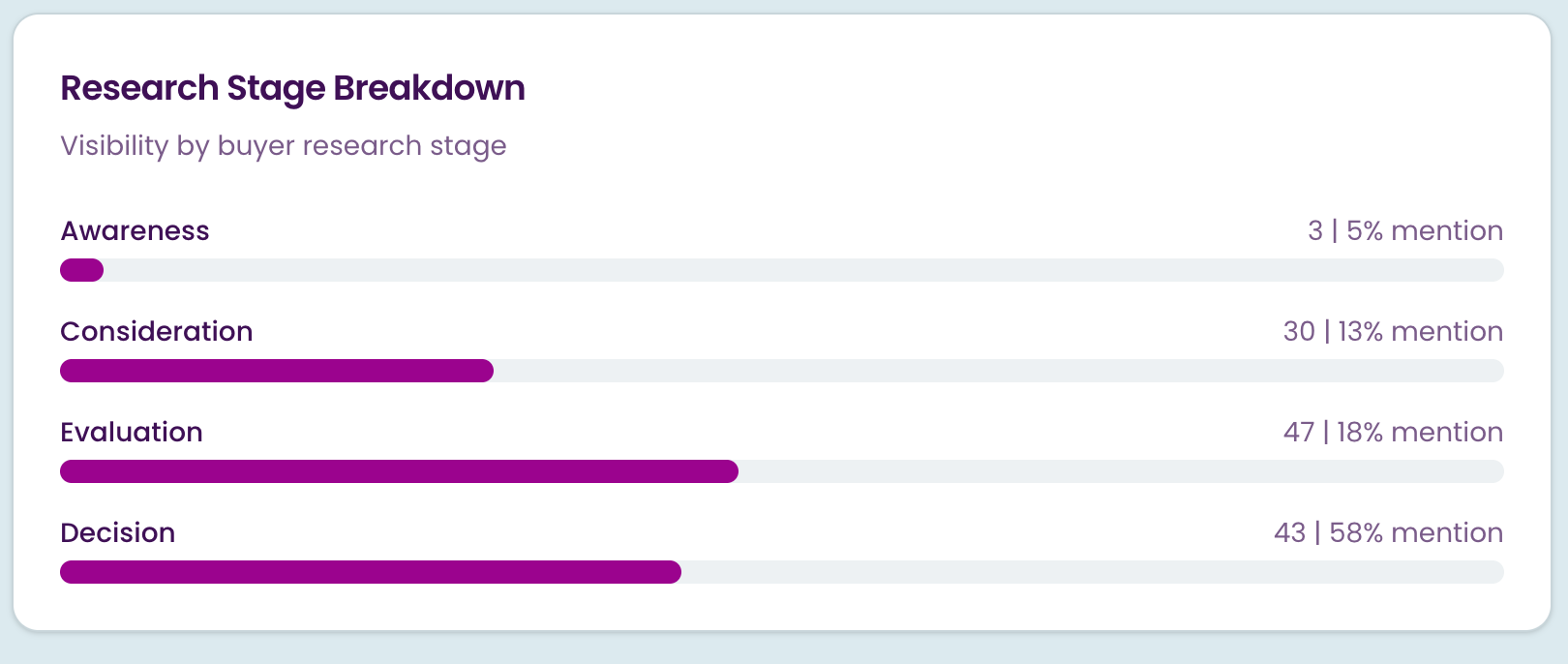
The strongest stage was Evaluation at 47/100. This suggests Revolut Business performs better once buyers are comparing options or asking more specific product-led questions. But the 3/100 awareness score is commercially significant because buyers often begin with broad questions before they know which provider to shortlist.
Cross-engine visibility varied
This audit tested four AI engines, which revealed how visibility differs across AI-led research environments.
GPT-4o produced the strongest average score at 35/100, while Gemini 2 Flash produced the lowest at 24/100. The cross-engine spread was 11 points.
This matters because buyers do not use one AI system. Product visibility can vary depending on which engine they ask, how that engine retrieves information, and which sources it gives weight to.
Revolut performed better when named directly
The highest-scoring examples showed that AI can describe Revolut Business effectively when the product is named directly or the prompt is highly specific.
This indicates that the product evidence exists, but is not being surfaced consistently in open-ended, early-stage category research.
AI produced a strong answer around native integrations with accounting, HR and productivity platforms including Xero, QuickBooks, FreeAgent, NetSuite, Sage Intacct and Zoho Books.
AI connected Revolut Business to potential savings from reduced transaction fees, FX costs and international banking friction.
AI gave a practical answer around holding native currencies, monitoring exchange rates and using multi-currency workflows for treasury control.
AI explained 1-click integrations, Open Banking APIs, Business API functionality and accounting-tool connectivity.
AI could explain the value of multi-currency accounts through third-party success-story evidence, though the answer was broader than Revolut-specific proof.
The awareness-stage gap was consistent across engines
The lowest-scoring examples came from broad, vendor-neutral awareness prompts. One prompt scored 0/100 across all four engines:
"What are the main approaches to managing multiple currency accounts in international business?"
Each engine produced a useful answer. But none of them reliably surfaced Revolut Business Multi-Currency Account as a specific product option.
This is exactly the product visibility gap. AI understands the category, but does not necessarily connect that category to the product.
AI gave a vendor-neutral overview of local bank accounts, multi-currency accounts and currency-management approaches, but did not surface Revolut Business.
AI discussed centralised treasury management and currency-exposure control, but did not connect the answer to Revolut Business.
AI explained multi-currency business bank accounts, separate currency accounts and international transaction approaches without surfacing Revolut Business.
AI described multi-currency accounts, separate bank accounts, monitoring, automation and FX strategies, but did not position Revolut Business as a named option.
AI explained the concept of multi-currency accounts in detail but did not connect the answer to Revolut Business.
Theme performance shows the strongest and weakest product signals
The strongest theme was Market Leadership at 45/100. This suggests AI has some recognition of Revolut Business as a major fintech or multi-currency provider.
But the weakest theme was Enhanced Security and Compliance at 24/100, and both Streamlined Currency Management and Cost-Effective Transactions scored below 30.
That is commercially important because security, currency management and transaction costs are central reasons businesses compare multi-currency accounts.
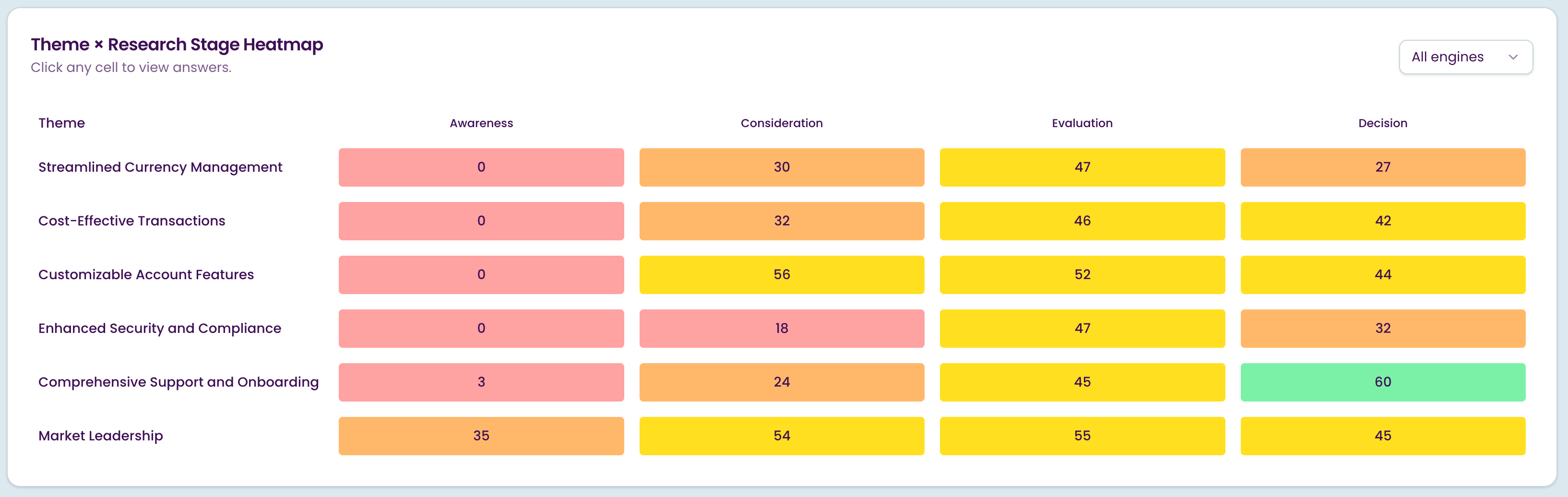
Revolut's brand and market leadership signals appear stronger than its product-specific signals around security, compliance, transaction cost and operational currency management. That distinction matters for business buyers who are trying to compare providers on risk, cost and operational fit.
The competitor picture
The competitive analysis tells a different story from the overall visibility score. Revolut Business led the answer-driven competitor set with a score of 2.6/5, above the competitor average of 2.0/5.
This means that when AI did compare providers, Revolut Business often appeared as a credible or leading option. But the low overall visibility score shows that leadership in comparison answers does not automatically solve awareness-stage invisibility.
Recognised Revolut Business strengths: multi-currency support, mobile and web account management, accounting integrations, competitive exchange rates and fee-free currency exchange up to a monthly allowance.
Surfaced weaknesses: limited support channels, lack of cash deposit facilities and no overdraft facility.
This audit measures AI visibility and answer quality. It is not financial advice and does not assess product suitability for any individual business.
What the audit proves
The Revolut audit shows why product-level AI visibility is more nuanced than brand tracking or competitor ranking.
Revolut Business can lead its competitor set and still have a weak overall visibility score. That is because different buyer questions produce different outcomes.
When buyers compare named providers, Revolut performs more strongly. When buyers ask broad category questions, the product often disappears.
From one audit, Odyssiant can show:
- where the product appears
- where it disappears
- which AI engines surface it more strongly
- which buyer stages are weakest
- which product themes need stronger evidence
- which competitors are being recommended
- what content, proof and comparison signals should be prioritised
What Odyssiant would fix first
Build awareness-stage category content
Create content around broad multi-currency account and international currency-management questions so Revolut Business is more likely to surface before the buyer has named a provider.
Strengthen security and compliance signals
Improve the visibility of evidence around business account security, regulatory protections, compliance controls, fraud prevention and risk management.
Clarify cost-saving proof
Create stronger evidence around transaction fees, FX savings, market-hours exchange, ROI and cost comparisons against traditional banks and fintech alternatives.
Improve support and onboarding evidence
Address common buyer concerns around customer support, onboarding, implementation, integrations and business continuity.
Retest across engines
Run the same prompt set again across GPT-4o, Gemini, Claude and Perplexity to see whether improved signals move answers across multiple AI environments.
The takeaway
Revolut Business shows why AI visibility needs to be measured by buyer stage, engine, theme and prompt type.
The brand can be strong. The competitor position can be strong. But if the product is absent when buyers ask broad category questions, it may still miss early shortlist formation.
That is the product visibility gap.
And it is measurable.
More from this series
Run your first AI visibility audit
Sign up for a free Odyssiant account and see where your product appears, where it is misunderstood, and what to fix first.